Awning Projection Size Is Measured Along the Slope
· 8 min read
As an Amazon Associate we earn from qualifying purchases. We compare what manufacturers publish with what owners report after real seasons outside. Links may earn us a commission, which never survives contact with a verdict.
Two suppliers, one number, different shade
Two awnings can both be sold as ten-foot projection and put a different amount of shade on your patio. Projection is not a standardised measurement, and it is not a shade measurement at all. Awning projection size, as quoted, tells you less than you think.
Rolltec defines projection as the distance from the wall down the fabric slope to the front bar, explicitly not the distance straight out from the wall. Roché defines it as if a tape measure were lying flat along the top of the fabric, with pitch not taken into account. Sunair also instructs buyers to measure the slope of the fabric rather than out from the wall along the ground, noting the two are different. GDCG simply treats projection and depth as the same thing.
So the industry is using one word for two measurements. On a 10 ft. awning at 15° of pitch, the gap between them is roughly four inches of horizontal reach: small on paper, decisive when it is the four inches between the far chair and the sun.
Ask which measurement you are being quoted
Before you order anything, email the supplier one line: is that projection measured along the slope or horizontally? If they cannot answer, treat the figure as a slope measurement, because at least two of the suppliers who publish a method (Rolltec and Sunair) define it that way.
What follows is about the difference between a quoted projection and the ground you can actually sit on later in the afternoon. Breslow makes the point bluntly: projection matters more than width, and it has to match the sun angle you are blocking rather than the depth of your patio. Width is what people fixate on. Slope is what costs them the shade.
The short version
- The pick: ADVANING Classic Series 13'X10', for you want the deepest practical shade over a full patio dining set and can run power to the wall.
- Also worth it: LX-Destin, for you have a wide wall and want a single awning rather than two smaller ones side by side.
- How this was decided: published specifications and buyer reports across 6 products, compared below.
Converting a quoted projection into ground you can sit on
A quoted projection is a slope length, not a ground measure. Rolltec states it plainly: a 10 ft projection installed at 15° inclination gives approximately 9'8" of horizontal cover on the ground. Four inches lost, before the sun has moved at all. Rolltec's worked example is the only figure any of these suppliers publishes; none of them gives a general formula or conversion table for translating a slope-measured projection into a horizontal one at other pitches.
Pitch is not optional. Roché recommends at least 14° for patio awnings to shed rain; GDCG puts the working band at 14° to 20°. So a pitch in that band, and the horizontal loss that comes with it, is the realistic case.
How the sun's movement changes it
Now move the sun. None of these suppliers publishes sun-angle figures by latitude, season or time of day, so the advice to match projection to sun angle cannot be worked through from their pages. GDCG says the general point directly: shade at noon does not mean shade at 4pm. Breslow adds the seasonal version. A projection that blocks June midday sun falls short by a September afternoon.
Depth costs head height, and the cost is fixed at installation. Sunair's 3/12 pitch rule puts the brackets of a 10 ft awning at 9'6", leaving about 7 feet of clearance under the front bar. Sunair also requires 7'6" from the patio floor to the bottom of any eave before the hardware will fit.
What a steeper pitch costs
Breslow notes that a steeper pitch sheds water faster but drops the front edge lower, which matters over a doorway, a walking path, or for tall people. None of these suppliers states how far the front bar of a given projection actually drops at a given pitch, so the trade-off cannot be calculated from their figures. Roché notes the installer fixes pitch permanently, so this is a one-time decision.
| Product | Size | Material | Mounting | Operation | Right for |
|---|---|---|---|---|---|
| ADVANING Classic Series 13'X10' | 13' x 10' | Aluminum | Wall mount | Electric motor | Best deep projection |
| LX-Destin | — | — | Wall mount | Manual crank | Best wide span |
| paramondo | 117.6"D x 98.4"W x 59"H | Polyester, Aluminum | Wall mount | Manual crank | Best small patio |
| 503 - Service Unavailable Error | — | — | Wall mount | Manual | Best custom sizing |
| 503 - Service Unavailable Error | — | Clear PVC vinyl | Wall or frame mount | Fixed | Best doorway rain cover |
| ShadePro Villa RV | — | Mesh screen panels | Awning rail and ground stakes | Attaches to existing awning | Best RV add-on |
Every spec above is quoted from the listing; the “Right for” column is our judgement.
Why 250cm is the size people regret
Ask what the ceiling is. You get two answers.
Roché sells patio awning projection in multiples of 50cm, all of them under 400cm. GDCG lists 4m and above as an ordinary option for large outdoor spaces. Nothing in either guide explains the gap: whether these are engineering limits, model-range limits or regional differences is unstated. Roché does say projection often needs to be 500cm less than the width to support the structure effectively, though it adds that its team advises case by case, and it offers no derivation for the rule.
The coupled figures make the distinction plain. Roché's largest single unit reaches 700cm wide; coupled Markilux 5010 units pair to 1390cm and the 1650 to 1410cm, with the 1700 allowing three units joined. Rolltec recommends partial coverage or more than one awning for patios over 24 feet wide. Breslow sells oversized frames such as the Madera Giant for spans a standard cassette cannot cover in one piece.
So when a quote says 4m, it is worth asking whether that is projection or width. Roché's own guide slips and uses "projection" where it means width when describing coupled units, which tells you how easily the two get confused.
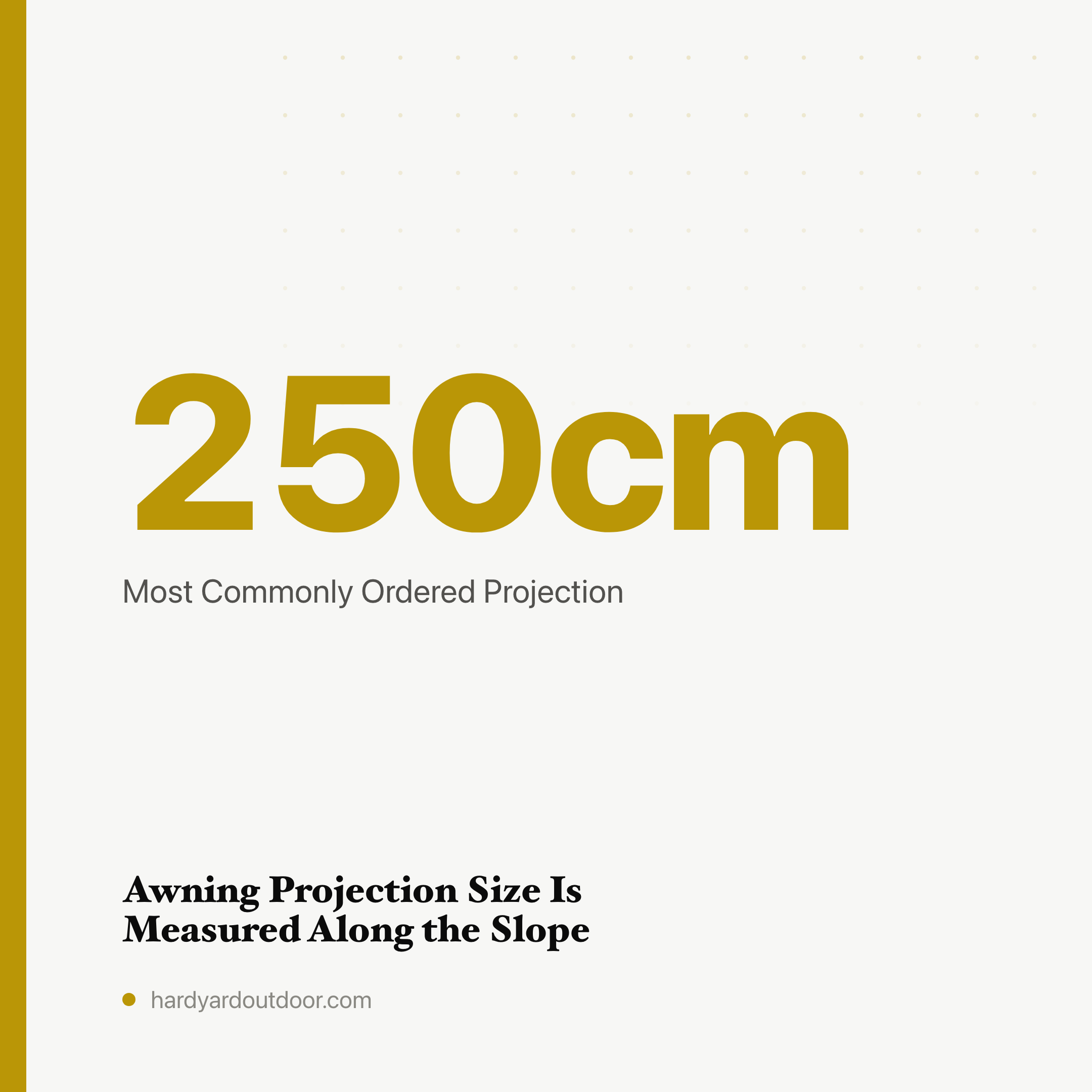
Roché's most commonly ordered patio awning projection is 250cm. GDCG's own matching puts 2m–2.5m at a small bistro table or compact seating area, and 3m–3.5m at larger patios, BBQ setups or small dining areas. No source explains why the commonly ordered size sits at the lower end of that range.
Sunair claims the other end: it warns that projections larger than 11'6" do not shed water well even with a good pitch. No mechanism is given and no other supplier here confirms a threshold, so treat it as one supplier's claim.
Six awnings against the same three criteria
Two things are checkable here: the projection the manufacturer published, and what the wall has to give up to carry it.
The evidence available here does not include product specifications for these units, and no source supports a method for converting a published projection into usable shaded depth at a given time of day.
Mounting demands are documented. Sunair specifies 8 inches of clear, unobstructed horizontal wall along the entire awning width at mounting height, and 2–3 feet of open wall beside a motorised unit so the tubular motor can be withdrawn if it ever fails.
Marygrove's January 2026 brand comparison ranks Marygrove itself first, so read it with that in mind. It records Advaning buyers reporting challenging DIY installs and limited post-install support. The mounting hardware differs by surface, and Marygrove notes brick, siding and stucco each need different fixings. It also notes that improper installation can damage siding, brick or stucco, and that in wind an unsecured awning can pull away from the wall entirely.
Which one for which wall
Before you order anything, send the supplier one line: "is that projection measured along the slope or horizontally?" Rolltec's own example puts the difference at about four inches on a ten-foot awning at 15° pitch, and no source gives a way to generalise beyond that. GDCG's rule for width is worth sending in the same email: at least 30cm wider than the door.
Match the awning to the wall, not to the catalogue:
- Larger patios and dining areas. GDCG matches 3m–3.5m to larger patios, BBQ setups or small dining areas, and 4m+ to large entertaining spaces with multiple seating areas.
- Small bistro table or compact seating. GDCG puts 2m–2.5m here.
- A space needing more projection than width. Roché notes Markilux and Weinor make Stretch and MiniMax designs using special folding arms; the Markilux 1700 Stretch reaches projections up to 400cm on widths as small as 225cm.
- A run wider than one unit covers. Roché's largest single patio unit is 700cm wide; Rolltec recommends partial coverage or more than one awning for patios and decks over 24 feet wide.
Roché's most commonly ordered patio awning projection is 250cm; GDCG puts 3m–3.5m at larger patios and dining areas.
Our call
ADVANING Classic Series 13'X10', best for you want the deepest practical shade over a full patio dining set and can run power to the wall.
A different situation changes the pick:
- For you have a wide wall and want a single awning rather than two smaller ones side by side: LX-Destin.
- For a small patio where you need real projection but only have about ten feet of wall: paramondo.
- For a wall whose usable width does not match any off-the-shelf awning size: 503 - Service Unavailable Error.
One caveat on the ADVANING Classic Series 13'X10': needs a power supply run to the mounting point
Questions
What does projection mean on an awning?
Projection is how far the awning reaches from the wall, but suppliers define it differently. Rolltec and Sunair measure it down the fabric slope to the front bar, not straight out from the wall. Roché measures flat along the top of the fabric with pitch ignored. GDCG treats projection and depth as identical.
Is awning projection measured flat or down the slope of the fabric?
It depends on the supplier, so ask before ordering. At least two suppliers that publish a method, Rolltec and Sunair, measure down the fabric slope. If a supplier cannot say which method it uses, assume slope, because that assumption costs you inches rather than surprising you after installation.
How much ground shade does a 10 ft awning projection give?
Rolltec states that a 10 ft projection installed at 15° inclination gives roughly 9'8" of horizontal cover on the ground, a loss of about four inches. No supplier publishes a general formula or conversion table for other pitches, and none gives sun-angle figures by latitude, season or hour.
Sources
- Patio Awning Sizes | A Buyer’s Guide | Roché Awnings accessed 2026-08-05
- What Size Awning Do I Need? | Liberty Awnings and Shades accessed 2026-08-05
- How to Measure for a Retractable Awning | Sunair News accessed 2026-08-05
- How To Measure | Rolltec® Retractable Awnings accessed 2026-08-05
- Top Awning Brands and What to Avoid accessed 2026-08-05
- What Size Retractable Awning Do You Need? Width, Projection & Shade Math | Breslow Design & Build accessed 2026-08-05
- Step-by-step guide to measuring for an awning. Cov... | Blog | GDCG accessed 2026-08-05