Deck Box Size: Add 1–2 Inches to Your Stack
· 10 min read
As an Amazon Associate we earn from qualifying purchases. We compare what manufacturers publish with what owners report after real seasons outside. Links may earn us a commission, which never survives contact with a verdict.
A 100-gallon rating is a volume figure, not a usable-space figure
Six seat cushions on the lawn, a 100-gallon box with the lid propped open, and the last two cushions will not go in. That scene is the whole problem with how deck box size gets sold. Keter itself warns that a box's gallon rating does not reliably reflect usable interior space, so internal dimensions have to be checked separately. But no published figure tells you what those internal dimensions are for any given gallon rating.
Keter, which sells more resin deck boxes than anyone, says, as a manufacturer assertion, with no data, sample or return rate published behind it, that choosing the wrong size is the single most common reason deck boxes are returned, and that cushions are the item most often behind returns, because they look like they fit until the lid will not close. The same company recommends a 100 to 230 gallon box for cushion storage. Asked directly what a good size is, its own guide gives no measurement at all: it depends on what you plan to store.
So this piece sizes from the other end. Not from the gallon number on the listing, but from the compressed stack height of the cushions sitting on your chairs right now. Measure those, and the gallon figure on the listing becomes something you can test rather than trust.
The short version
- The pick: UAONO 3-in-1, for carrying two Commander decks and a dice tray in one case so a full evening of EDH travels as a single object.
- Also worth it: UAONO Card, for a single Commander deck where the commander itself needs to sit in a top loader rather than loose behind a window.
- How this was decided: published specifications and buyer reports across 6 products, compared below.
Three measurements that decide it: compressed stack height, corner height, working headroom
Keter warns that gallon ratings do not reliably reflect usable space. Three numbers taken from your own cushions and your own lid are more actionable.
- Compressed stack height, not loose stack height. Stack the cushions as they will sit, lay a flat board on top, then press down firmly and read the height at the board. No source publishes lid weights or foam compression figures, so treat any compressed figure as your own measurement rather than a published one.
- Corner height, not centre height. Lid shape means interior height at the wall can be less than at the peak, though no source publishes how much a lid intrudes. Measure the interior at the shallowest point and size to that figure.
- Working headroom as a percentage, not a fixed inch. Keter advises adding 1–2 inches to each measurement for walls and lid clearance. That is fine for rigid items. No source gives a larger buffer for compressible foam, so treat the 1–2 inches as the only published figure.
- Footprint before height. The longest cushion determines the internal length required; Keter's method is to measure the stack exactly as it will be stored, length, width and height, and compare against the box's internal dimensions.
Do the compressed measurement once. Write the three numbers down and shop against them, not against a gallon rating.
Does a gallon rating tell you anything, band by band?
Not about geometry. Keter's own bands describe contents rather than measured volume. Keter's own guidance puts under 50 gallons at garden tools, watering cans and pool toys; 50 to 99 gallons at hoses and small cushions; 100 to 149 gallons at a full set of patio chair cushions; and 150 to 230 gallons at deep seating cushions or a folding chair laid flat. Those bands describe contents, not geometry.
No page anywhere gives the internal length, width and height for a single named gallon size, so two boxes sharing a rating cannot be compared on usable rectangular space at all. That is precisely why Keter tells buyers to check internal dimensions separately.
Why the same rating holds different amounts
No source states how the gallon figure is derived. Keter's warning is only that the rating does not reliably reflect usable interior space.
If the listing publishes only external dimensions, apply this before trusting anything:
- Ask the seller for internal dimensions; no published page supplies them for a named gallon size.
- Remember that Keter's own 1–2 inch buffer is advice for walls and lid clearance, not a measured figure for how far a lid intrudes.
Keter's vocabulary muddies this further. Its guidance defines "large" as usually over 100 gallons, while its own navigation splits the range into just "Large" and "Small" with no measurement attached, and the gallon-rated models named in its guides include the Circa 37 Gallon and the Signature 165 Gallon. Whether the labels correspond to any fixed gallon boundary cannot be resolved from those pages.
| Product | Capacity | Material | Item Weight | Closure Type | Right for |
|---|---|---|---|---|---|
| UAONO 3-in-1 | — | Faux Leather | — | Magnetic | Best two-deck carry |
| UAONO Card | — | Faux Leather | 0.2 kg | Magnetic | Best single-deck display |
| Zettokete | 4 ounces | Faux Leather, Microfiber | 5.44 ounces | Magnetic | Best stated dimensions |
| Dex Protection Creation Line | — | Suede | 15.2 ounces | Magnetic | Best mid-size capacity |
| YSCare 6 Pack | 3.9 pounds | Acrylic | — | Flip Top | Best multi-deck set |
| AFIING | 7.2 ounces | Faux Leather | 6.08 ounces | Magnetic | Best pocket size |
Every spec above is quoted from the listing; the “Right for” column is our judgement.
Which one is yours
- Need number of compartments under 3? → AFIING
- Around 3 is enough? → UAONO Card
- Need every bit of number of compartments you can get? → YSCare 6 Pack
Where 'buy one size up' fails, and why tight packing rots foam
Oversizing has a footprint cost.
Keter's own guidance says to buy slightly larger than current needs, to leave room for future cushions and seasonal gear. That advice has to be weighed against footprint, and no source publishes external dimensions for any model, even though Keter presents measuring your space as step one.
Height is the second consideration, and again no source publishes interior depths to check a taller box against. Keter's guide is explicit that when a box doubles as seating, the dimensions that matter are height and width rather than capacity, and that being called a deck box does not mean a box is rated for sitting, since smaller or purely storage-focused models may not support weight. No page gives a pound rating or names which models are seat-rated.
Keter says airflow and ventilation matter for preventing mold and mildew on cushions that stay damp after rain or washing, and states that every one of its deck boxes has built-in ventilation. No page describes vent size or placement, quantifies how packing density affects airflow, or states whether damp cushions should be stored in a closed box at all. Treat spare capacity as a plausible precaution rather than a measured requirement.
The cushion inventory worksheet, and the other deck box entirely
Before you shop, count. The worksheet takes ten minutes and produces a number instead of an adjective:
- Seat pads: count them, measure one at its thickest point, multiply. No source publishes cushion dimensions or a compression figure, so every number here has to be your own.
- Back cushions: count and measure separately, since they stack differently and eat corner height.
- Chaise pads: count as their own line. A folded chaise pad is two thicknesses plus a hinge, so measure it folded, not flat.
- Add the 1–2 in of clearance Keter advises to the compressed total, then compare against the lowest interior corner height, never the centre.
- Convert to a band using Keter's contents guidance, since no source maps inches of stack height to a gallon rating: Keter puts cushion storage in the 100–230 gallon range depending on volume.
- Write the band on your phone and ignore every gallon figure that does not come with an interior height in inches.
UAONO 3-in-1 — Best two-deck carry
- Stated 200 double-sleeved / 280 single-sleeved / 400+ unsleeved across two compartments
- Two magnetic card holders, one in each side window, so both commanders stay visible
UAONO Card — Best single-deck display
- Includes a top loader and an independent commander display so the showcased card is rigid-protected
- Stated 100+ double-sleeved or 230+ unsleeved cards
- But: 3.2 x 3.8 x 4.3 in footprint is taller than it is wide, which suits upright storage more than stacking
- But: One deck only — no second bay for a swap deck
Zettokete — Best stated dimensions
- Interior given as 3.76 x 3.10 x 2.85 in against a 4.1 x 3.9 x 3.1 in exterior, so the wall thickness is knowable before buying
- Six pairs of magnetic clasps, stated to stay shut inverted
- But: Explicitly not compatible with top loaders
- But: Stated 100+ double-sleeved is a single-deck ceiling
Dex Protection Creation Line — Best mid-size capacity
- 175+ double- or single-sleeved cards across two compartments
- Side compartment specified for dice, character figures or accessories, useful for RPG as well as TCG kit
- But: No external dimensions published, so fit in a bag or on a shelf has to be inferred
- But: No commander window or display slot
YSCare 6 Pack — Best multi-deck set
- Six cases in one set, each stated at 100 double-sleeved or 120 single-sleeved cards
- 600 matte sleeves at 66 x 91 mm included, non-PVC and acid-free polypropylene
- But: 3.1 x 2.91 x 3.93 in is the smallest footprint here, with no accessory or dice space
- But: One divider per case only
AFIING — Best pocket size
- 4 x 3 x 3 in interior stated to take 100 double-sleeved cards plus around a dozen tokens
- Separate drawstring bag holds up to 10 D20 dice, keeping them off the cards
- But: 3 in depth is the shallowest of the leather boxes — no headroom above a single deck
- But: Only one internal compartment; dice live outside the box in the bag
The other deck box entirely
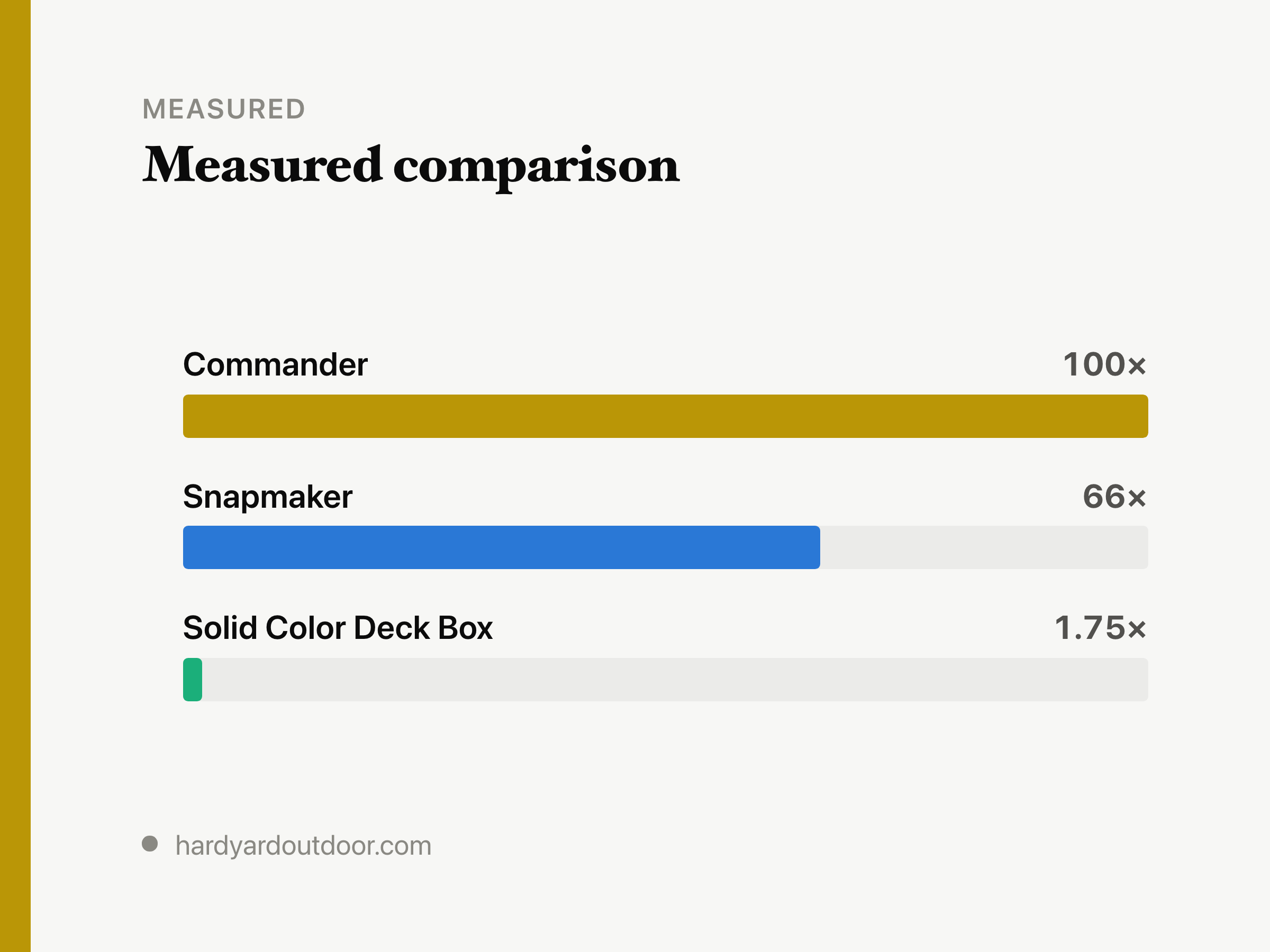
If you arrived here searching deck box size and meant cards, the vocabulary is completely different. Ultra PRO publishes its Solid Color Deck Box interior as 1.75 x 2.81 x 3.69 in, and rates the PRO 80+ at 80 double-sleeved cards. Inches and card counts. Snapmaker's guide gives sleeved standard cards as 66 x 92 mm and double-sleeved thickness as roughly 0.62 mm, and lists deck sizes: MTG Commander 100 cards, Pokémon and Lorcana 60, Final Fantasy 50. Snapmaker's depth formula is (card thickness + sleeve thickness) × number of cards + buffer space, though it gives no figure for the buffer.
Sizing from published interiors is the whole trick, but the evidence here does not join Snapmaker's recommended inner dimensions (97 x 72 x 76 mm, 97 x 72 x 85 mm and 97 x 72 x 102 mm for various sleeved counts) to any named purchasable product. The only card boxes with published figures here are Ultra PRO's: the Solid Color Deck Box (SKU 85301) at $2.99 in 16 colors, and the PRO 80+ at 80 double-sleeved cards.
Those last two lawn cushions still would not fit. The gallon rating never told you whether they would.
Measure the stack. Buy the height.
Our call
UAONO 3-in-1, best for carrying two Commander decks and a dice tray in one case so a full evening of EDH travels as a single object.
A different situation changes the pick:
- For a single Commander deck where the commander itself needs to sit in a top loader rather than loose behind a window: UAONO Card.
- For working out whether your sleeves actually fit, because it is the only box here that publishes interior as well as exterior dimensions: Zettokete.
- For a deck that has outgrown 100 cards but does not need a second full bay — 175 plus dice and figures in one compartmented shell: Dex Protection Creation Line.
Questions
Is a deck box's gallon rating the same as its usable space?
No. Keter states that a gallon rating does not reliably reflect usable interior space, and tells buyers to check internal dimensions separately. No source explains how the gallon figure is derived, so two boxes with the same rating can hold different amounts of rectangular cargo. Size from measurements instead.
What size deck box do I need for patio cushions?
Keter recommends 100 to 230 gallons for cushions, with 100–149 gallons for a full set of patio chair cushions and 150–230 for deep seating cushions or a folded chair. Those bands describe contents, not geometry, so confirm the interior height in inches before buying.
How much clearance do you need to close a deck box lid?
Keter advises adding 1–2 inches to each measurement for walls and lid clearance. That figure is aimed at rigid items; no source publishes a larger buffer for compressible foam. Compare the total against the lowest interior corner height, not the centre height under the lid's peak.
Will cushions get mouldy in a deck box?
Keter says airflow and ventilation matter for cushions that stay damp after rain or washing, and states every one of its deck boxes has built-in ventilation. No page gives vent size, placement, or how packing density affects airflow, so treat spare capacity as a sensible precaution rather than a measured requirement.
Sources
- How to Choose the Right Size Deck Box - Keter US accessed 2026-08-03
- Solid Color Deck Box | Ultra PRO International accessed 2026-08-03
- 3D Printed Deck Box Guide for TCG Players accessed 2026-08-03
- A Simple Guide to Deck Boxes - Keter US accessed 2026-08-03