Fire Pit Clearance: Distance From Walls and Seating
· 10 min read
As an Amazon Associate we earn from qualifying purchases. We compare what manufacturers publish with what owners report after real seasons outside. Links may earn us a commission, which never survives contact with a verdict.
The 3-Foot and 25-Foot Numbers Are Both Correct
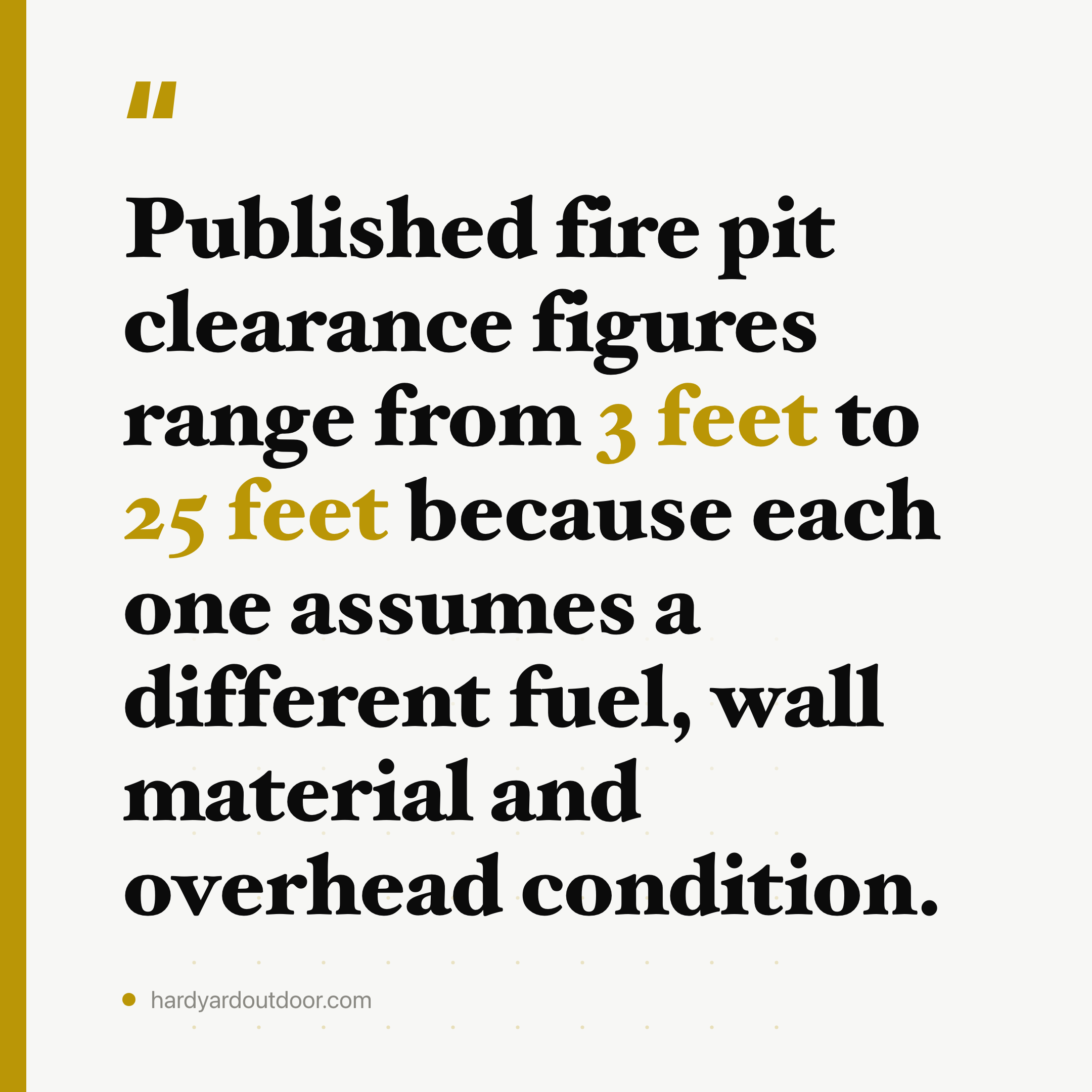
A 24-inch smokeless pit on a 12-by-14 slab, back door six feet away, cedar fence eight feet the other side. Search for fire pit clearance and you get told 36 inches, then 10 feet, then 25 feet, all on page one. None of those numbers comes with the context that would let you choose between them, and none of the pages explains the gap.
The sources do not agree, and none of them reconciles the difference. DreamCast attributes the smaller gas figures to gas burning without stray embers or unpredictable flame spread, but the figures do not sort cleanly by fuel: Fire Pit Surplus asks for only 3 feet on wood-burning pits while quoting 5 to 10 feet for gas.
If your yard is under 20 feet across at its widest, this matters before you buy anything. Get the sequence right and you know which of the eleven pits below your slab can comfortably hold, and which diameter puts your fence inside the setback. Get it wrong and you own a pit you can only run in the middle of the lawn.
What each source actually says
- 36 inches, gas, combustible wall. DreamCast Design and Production specifies a minimum 36 inches from combustible walls or structures. Montana Fire Pits sets the same floor for gas units.
- 10 to 25 feet from structures. Fire Pit Surplus puts fire pits 10 to 25 feet from structures, fences or overhangs, and gas units at 5 to 10 feet. SoCal Firepits likewise calls for 10 to 25 feet from structures depending on fire pit diameter.
- Wood burning, 10 to 15 feet. DreamCast associates wood-burning pits with this range and attributes the gap to gas burning without stray embers or unpredictable flame spread.
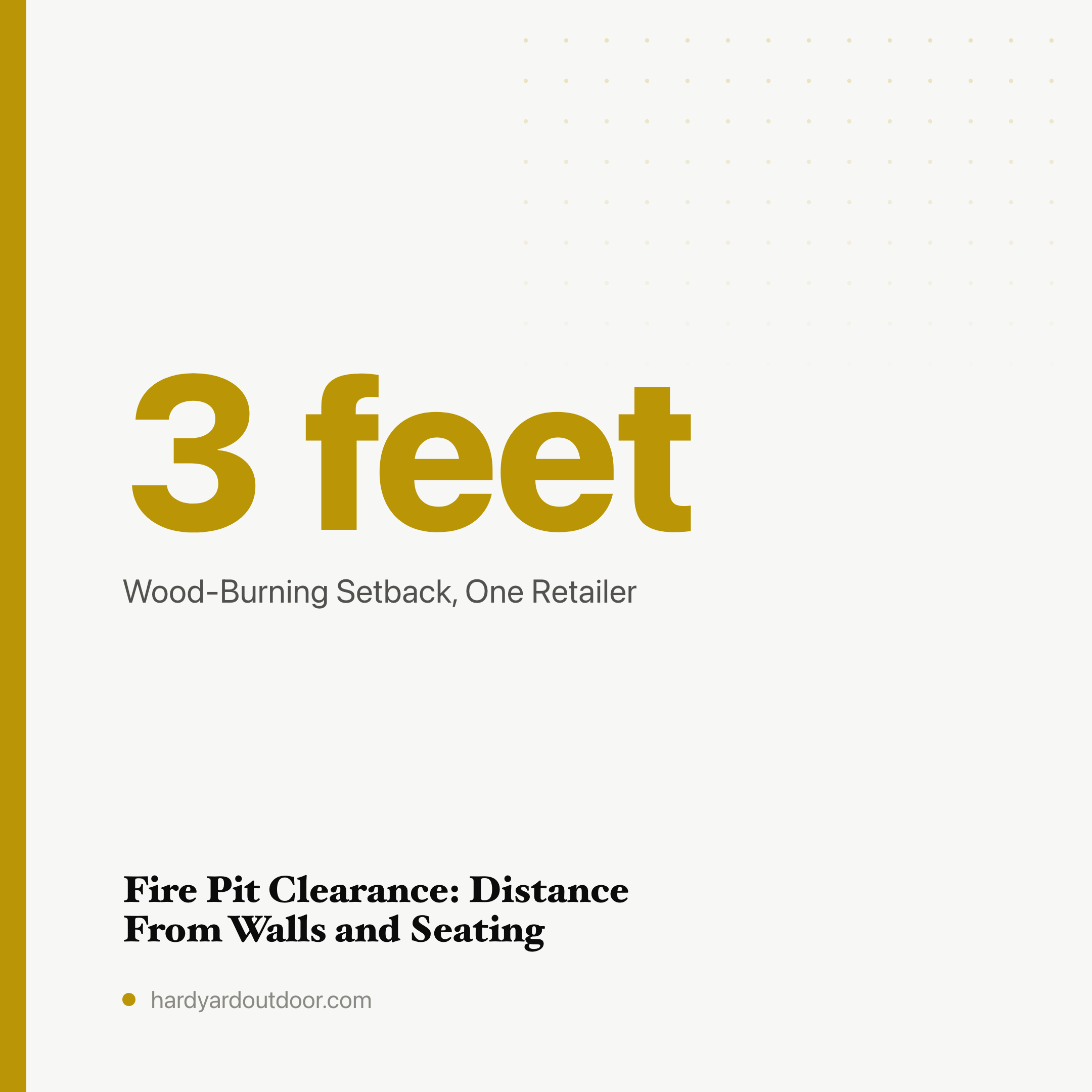
- 3 feet, wood burning. Fire Pit Surplus advises 3 feet for wood, explicitly to account for heat and flying embers — the outlier among these sources.
SoCal Firepits is the only source here that indexes setback to diameter: 24-inch and 30-inch pits at 10 feet, 36-inch pits at 15 feet. Read that backwards. On its numbers a wider bowl does not just cost more fuel, it moves the recommended setback out by five feet, which means diameter is a decision you make after measuring the yard.
One named code undercuts all of it. The same source notes Orange County mandates only 2 inches of clear space between fireplaces and combustible construction. Check your own authority; municipal rules vary, and DreamCast advises checking product documentation and local authorities before installation.
The short version
- The pick: Solo Stove Yukon, for 27-inch tall-flame pit for big groups where seating must be pushed well back.
- Also worth it: Breeo X, for largest wood burner here — needs the widest clearance ring from siding and seating.
- How this was decided: published specifications and buyer reports across 11 products, compared below.
Overhead: nobody publishes it
Vertical clearance is where the published guidance goes quiet. Sideways, everyone gives you a number. Upward, fewer do.
Start with the floor: DreamCast Design puts the minimum at 84 inches — 7 feet — to a non-combustible structure overhead on its gas fire pits, and says higher-BTU models need more than that. That is the best case. A stucco soffit, a stone underside, a steel canopy. Nothing that will char.
For anything combustible above the flame, Montana Fire Pits calls for at least 10 feet to the ceiling or overhang. Overhanging tree branches count as combustible too, with DreamCast putting them at 7 to 10 feet. The sources are not aligned here. SoCal Firepits asks for a 15-foot overhead minimum, a different order of caution entirely, and no source reconciles the two.
Now the part that matters more than the figure. A wood-beam pergola, a fabric shade panel, a woven roof: DreamCast says these all require more than the 84-inch non-combustible minimum, without saying how much more.
No source in this set gives an overhead figure for a wood-burning or smokeless pit at all. Solo Stove's Yukon is a 27-inch-diameter unit, per Wirecutter; what it needs above it is not documented here.
| Product | Product Dimensions | Material | Item Weight | Color | Right for |
|---|---|---|---|---|---|
| Breeo X | 34"D x 34"W x 14"H | Corten Steel | 28.12 kg | Corten Steel | Best permanent placement |
| Solo Stove Yukon | 29"D x 29"W x 18.5"H | Stainless Steel | 40.4 pounds | Ash | Best for big groups |
| Solo Stove Bonfire | 19.49"D x 19.49"W x 17.52"H | Stainless Steel | 21.7 pounds | Ash | Best small-yard option |
| TIKI Patio | 24.75"D x 24.75"W x 18.75"H | Stainless Steel | — | Black | Best stated heat zone |
| Cuisinart | 24.5"D x 24.5"W x 17"H | Alloy Steel, Stainless Steel | 22 pounds | Cleanburn Fire Pit | Best wind protection |
| Breeo Smokeless | 34"D x 34"W x 14"H | Stainless Steel | 31 pounds | Stainless Steel | Best repositionable pit |
| Solo Stove Mesa | 7"D x 7"W x 8.6"H | Stainless Steel | 2.3 pounds | Gunmetal | Best tiny spaces |
| PACKFIRE 17" | 17"D x 17"W x 22.4"H | Aluminum, Stainless Steel | 27.5 pounds | Black | Best carried in |
| Fireside Outdoor | 24"D x 24"W x 15"H | Stainless Steel | 8 pounds | Silver | Best leave-no-trace |
| Outland Living Firebowl | 24"D x 24"W x 13"H | Alloy Steel, Stainless Steel | 34 pounds | Black | Best for fire bans |
| Ninja Fireside360 | — | — | 40 pounds | Stone | Best no-ember option |
Every spec above is quoted from the listing; the “Right for” column is our judgement.
Which one is yours
- Need global trade identification number under 00869179000293? → Breeo Smokeless
- Around 00869179000293 is enough? → Fireside Outdoor
- Need every bit of global trade identification number you can get? → Ninja Fireside360
Measure three things first
Take these three measurements with a tape, on the ground, before you look at a single bowl diameter. Pit size is an output of the yard, not an input.
- Walk the wall and count the wood. Non-combustible brick or stone walls do not require the same clearance, but DreamCast is explicit that a brick structure with any wooden component — frame, gate, or trim — still requires the full 36 inches. "It's a brick house" is not an answer if the back door is timber.
- Measure to the nearest combustible thing, not the nearest wall. The fence post, the shed corner. Whichever is closest sets your setback.
- Add the numbers up rather than picking one. SoCal Firepits puts a 36-inch pit at 15 feet from structures on a standard patio, and 20 feet poolside. Fire Pit Surplus asks for 6 to 7 feet clear on all sides as a general rule. Both are describing different failure modes.
- Then add the seating ring and the walkway. DreamCast wants a 36-inch walkway around the entire seating arrangement, and SoCal Firepits wants 36 inches of clear space around the pit perimeter with egress paths at least 36 inches wide.
Here is what that costs in ground. A 36-inch pit, 15 feet of setback on the two nearest sides, chairs pushed back and a 3-foot walk behind them: on SoCal's and Fire Pit Surplus's figures you are consuming well over 30 feet of clear diameter before anything else lives in the yard. DreamCast's separate advice that a pit occupy no more than a third of the patio is the same constraint expressed politely.
None of these sources gives a threshold below which a given pit simply does not fit, or says what is actually being risked when a patio cannot meet the figures.
Seating is two numbers, not one
Wirecutter measures the Solo Stove Classic Bonfire at a 17.5-inch pit opening and 14 inches high. What seat distance a wood-burning pit needs is not something any of these sources states — every seating figure below was written for gas.
DreamCast puts the seat-to-rim figure at 15 to 24 inches, calling anything under 15 inches a limit on safe movement around the fire, and separately recommends 18 to 24 inches with 15 as the tight-space minimum. Montana Fire Pits pushes it back to 22 to 24 inches. Fire Pit Surplus accepts 18 to 24 inches, but only for gas, on the grounds that a contained flame throws no embers.
That caveat matters. Those figures are given for gas fire features. No source in this set gives a seating distance for a wood-burning pit at all.
Comfort distance runs the other way. SoCal Firepits gives the heat radius as 3 to 5 feet for a 24- to 30-inch pit, rising to 5 to 8 feet at 36 to 42 inches. It puts the radius at 8 to 12-plus feet for 48-inch and larger installations. None of these sources sets those radii against a seating minimum.
Smokeless pits break the pattern. Wirecutter reports that all smokeless designs project heat upward, cutting the radiant heat felt by people sitting nearby, so a smokeless pit warms nearby seating less than an ordinary bonfire. Both brands sell a heat deflector as a paid accessory to compensate. Budget for it if the pit is your heat source rather than your view. The Solo Stove Bonfire 2.0 is the one worth this compromise on a compact slab, though its 17.5-inch opening is smaller than Wirecutter's other picks, so standard-size logs have to be stacked carefully. For directed warmth instead, see what patio heater BTU actually buys you at four feet.
Which pit for which yard
SoCal Firepits indexes setback to bowl diameter rather than using one flat figure: 24- and 30-inch pits at 10 feet, 36-inch pits at 15 feet. On those numbers, width is not just a comfort preference, so the yard is worth measuring before the diameter is chosen. No other source here indexes setback to diameter.
Run the arithmetic on the largest case. SoCal Firepits places a 36-inch pit at 15 feet of setback and puts the heat radius on a 36- to 42-inch unit at 5 to 8 feet. Stacked, those figures consume a large clear circle before a single chair exists — though no source states whether these are hard minimums or the point at which failure begins.
Grouped by what your yard allows
- Widest yards only. The larger units, including Solo Stove's 27-inch-diameter Yukon, which Wirecutter lists alongside the 15-inch Ranger. SoCal Firepits places 24- and 30-inch pits at 10 feet of setback.
- Mid-size slabs with a deck edge. The Solo Stove Bonfire, which Wirecutter says can be used on a deck with the add-on stand, a stand that often ships bundled with the stove. If the deck is the constraint, that is the one to buy.
- Tight ground, no ember tolerance. A propane unit. Specifications and any burn-ban exemptions for individual models could not be verified against these sources.
Portable and tabletop units are a separate category. No source in this set gives clearance figures for portable wood-burning pits or fire bowls at all.
Everything above comes from manufacturer and retailer guidance and third-party review figures. Nothing here was measured on site, and none of these sources cites an actual code or standard for setback distance.
That 12-by-14 slab with a door at six feet and cedar at eight? SoCal Firepits would put a 24-inch pit at 10 feet from structures, which that slab cannot give. DreamCast and Montana Fire Pits would call 36 inches sufficient for a gas unit. Nothing in these sources resolves which figure applies to your fence.
Our call
Solo Stove Yukon, best for 27-inch tall-flame pit for big groups where seating must be pushed well back.
A different situation changes the pick:
- For largest wood burner here — needs the widest clearance ring from siding and seating: Breeo X.
- For mid-size patio pit that fits standard clearance on a compact deck-adjacent slab: Solo Stove Bonfire.
- For 25-inch pit with included stand that lifts heat off the patio surface: TIKI Patio.
One caveat on the Solo Stove Yukon: 29" x 29" x 18.5" and around 44 pounds, the largest and heaviest wood pit here
Questions
How much clearance should a fire pit have?
It depends on fuel and wall material. DreamCast and Montana Fire Pits set 36 inches as the minimum from combustible walls for gas units. Fire Pit Surplus and SoCal Firepits ask for 10 to 25 feet from structures, fences and overhangs, with wood-burning pits generally cited at 10 to 15 feet.
How far away from a house should a fire pit be placed?
For a gas fire pit, 36 inches from a combustible wall is the published minimum. For wood-burning, cited ranges run 10 to 15 feet, and some retailers say 10 to 25 feet from any structure. SoCal Firepits indexes it to diameter: 24- and 30-inch pits at 10 feet, 36-inch pits at 15 feet.
How far should seating be from a fire pit?
Published seat-to-rim figures are 15 to 24 inches, with 18 to 24 inches typical and 15 inches the tight-space minimum. Montana Fire Pits pushes it to 22 to 24 inches. Every one of those figures was written for gas fire features; no source in this set gives a seating distance for wood-burning pits.
Can you put a fire pit under a covered patio or pergola?
Only with the right overhead. DreamCast puts the minimum at 84 inches to a non-combustible structure such as stucco or stone, and says higher-BTU models need more. Combustible ceilings, wood-beam pergolas and fabric shade panels need more than that — Montana Fire Pits says at least 10 feet.
Does a fire pit need clearance from a brick or stone wall?
Non-combustible brick or stone does not require the same clearance, but DreamCast is explicit that a brick structure containing any wooden component — frame, gate or trim — still requires the full 36 inches. Measure to the nearest combustible thing, not the nearest wall.
Is 3 feet enough clearance for a wood-burning fire pit?
Fire Pit Surplus advises 3 feet for wood-burning pits, but it is the outlier. DreamCast associates wood-burning with 10 to 15 feet because of stray embers and unpredictable flame spread, and other retailers cite 10 to 25 feet. Check local authorities; municipal rules vary widely.
Sources
- The 5 Best Smokeless Fire Pits of 2026 | Reviews by Wirecutter Advertisement accessed 2026-08-03
- An Outline for Gas Fire Pit Dimensions & Construction - Montana Fire Pits accessed 2026-08-03
- Fire Pit Size Calculator: How Big Should Your Fire Pit Be? accessed 2026-08-03
- Fire Pit Size Guide: Find the Perfect Fit for Your Space - DreamCast Design and Production accessed 2026-08-03
- What Size Fire Pit is Best for Entertaining? Complete Sizing Chart for accessed 2026-08-03
- Gas Fire Pit Layout & Clearance Guide: Placement Done Right - DreamCast Design and Production accessed 2026-08-03