How Many Lumens Do Solar Path Lights Really Need?
· 9 min read
As an Amazon Associate we earn from qualifying purchases. We compare what manufacturers publish with what owners report after real seasons outside. Links may earn us a commission, which never survives contact with a verdict.
The recommended number and the tested number are 20x apart
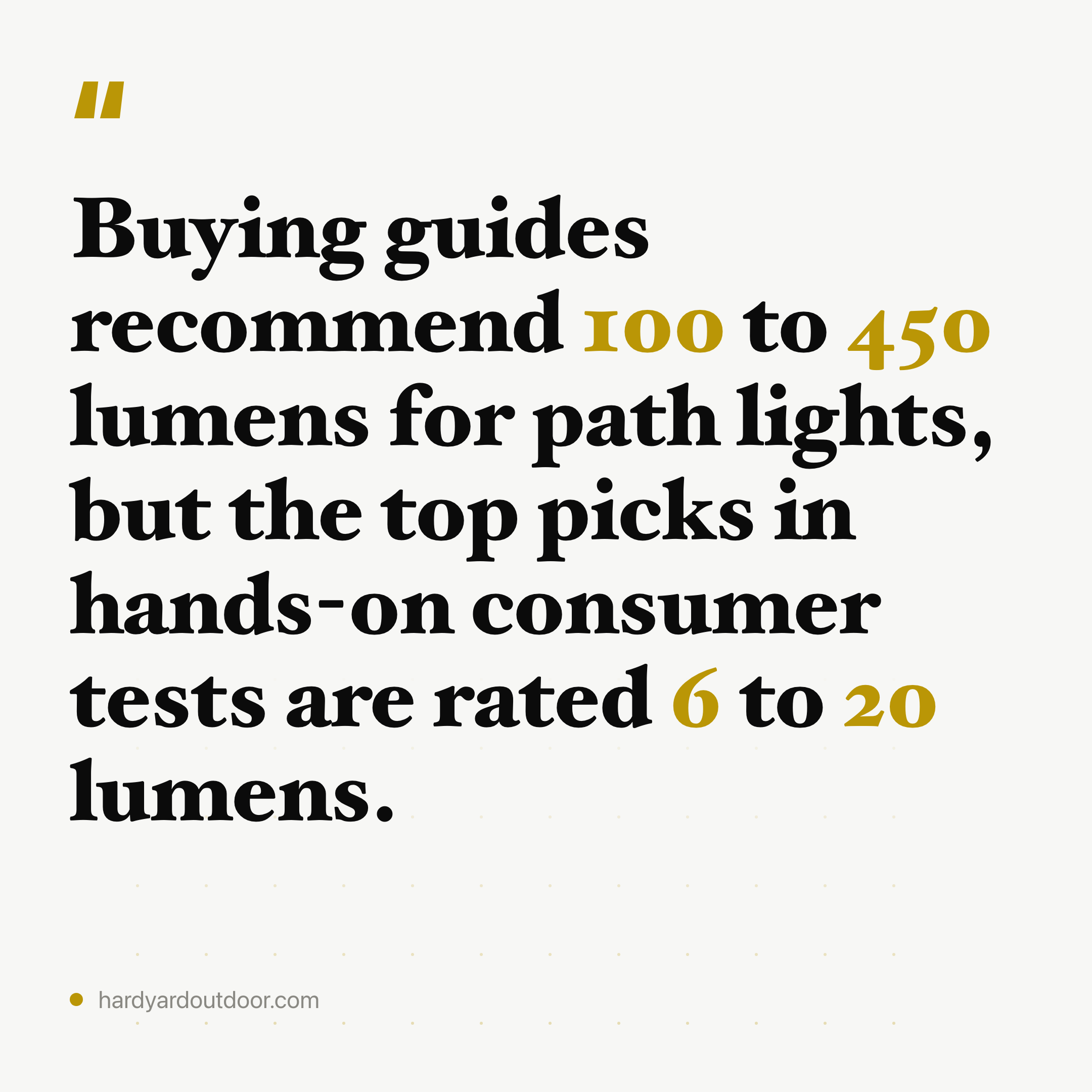
Buy for 6 to 20 lumens per fixture, because that is roughly what the top picks in published consumer tests actually produce. The solar path light lumens figures printed in most buying guides (100, 200, 450) sit far above the top-rated fixtures in those tests, though no source explains why the two sets of numbers diverge.
Look at the two number sets together. Greenshine, a commercial solar lighting manufacturer, recommends 450 lumens for walkway path lights. Another solar lighting company puts the figure at 100 to 200 lumens. PacLights recommends 150 lumens or more for longer pathways. Those are the numbers a reader arrives carrying.
Now the tested outputs. Chris Loves Julia's winner after more than 14 lights over two years, the Better Homes & Gardens Elijah, is rated at 20 lumens. Bob Vila researched over 50 sets and named the Beau Jardin its Best Overall at 10 lumens; its Best Bang for the Buck, the Maggift, is 6 lumens, which Bob Vila flags as a downside. The dimmest units Chris Loves Julia tested also came in at 6.
That is a gap of 20x at the generous end and 75x against Greenshine's figure. The brightest light Chris Loves Julia tested, the Frontgate Pro Series VI, is rated at only 60 lumens at $84.50 per fixture. Ten of those is $845.
What is at stake is buying the wrong category. No source states what lumen output is actually needed for safe footing on a residential path, so the threshold at which marking becomes seeing is undocumented. For uplighting a house or large trees, Chris Loves Julia recommends hard-wired lighting rather than solar.
The short version
- The pick: BeideLt 39LED, for it is the right answer when the path genuinely needs to be lit rather than marked, because 39 LED beads per head put out far more usable light than the single-bead decorative stakes.
- Also worth it: LETMY, for it is the right answer for someone lighting a full walkway in one purchase who wants the light to last deep into the night rather than fade after dinner.
- How this was decided: published specifications and buyer reports across 6 products, compared below.
Two jobs the '100–200 lumens' advice conflates
Bob Vila's testers put the 6-lumen Maggift stakes down a sidewalk and reported the lights still emitted enough soft white glow to see the sidewalk clearly. Six lumens. Chris Loves Julia does distinguish 'glow' lighting from 'safety lighting', warning that the unrated Alfiot lights are fine for glow but should be avoided if you want safety lighting, though the review never gives a lumen figure for the threshold between them.
In hands-on testing, low-output sets were reported as adequate for seeing the walkway: Bob Vila's 6-lumen Maggift pick still showed the sidewalk clearly, and its 10-lumen Beau Jardin Best Overall pick ran dusk-to-dawn. PacLights recommends 150 lumens or more for longer pathways and 50 to 100 lumens for shorter or decorative paths, and Greenshine states that a 450-lumen fixture illuminates an area about 10 feet in diameter. No consumer solar path light in the Chris Loves Julia test reached 150 lumens, though Bob Vila tested a 150-lumen Osord set.
Two misreadings to avoid
The first is inherited from Chris Loves Julia. That review names a 20-lumen light its winner and says it put out the most lumens of anything tested, while the same page lists the Frontgate Pro Series VI at 60 lumens and says the Pro Series VI gave off the most light of any path light tested. Both statements cannot hold. On the review's own figures, the 60-lumen fixture is the brighter one, though the tester found its cool-toned true white too cool.
The second is PacLights' quoted range: it states solar path lights typically run from 10 to over 200 lumens, with the highest models exceeding 300. The top end among lights in the Chris Loves Julia test is 60 lumens, and Bob Vila's brightest tested set was 150. Those are also manufacturer ratings, not instrument measurements.
| Product | Size | Material | Item Weight | Color | Right for |
|---|---|---|---|---|---|
| BeideLt 39LED | 24.60" in height x 7.48" in diameter | PP + ABS Plastic | 0.98 kg | Cool White | Best actual brightness |
| LETMY | 8 Pack | Plastic | 3.9 pounds | Black | Best long runtime |
| BITPOTT | — | Plastic | 4.9 pounds | Black | Best for weak sun |
| Springwind 10 | 10 Packs | Plastic | — | Warm White Light-PK10 | Best large-area coverage |
| GIGALUMI 6 | 6 Pack | Plastic | 907 g | Warm White | Best decorative pattern |
| GIGALUMI Solar | 12 PACK | Plastic | 680 g | Warm White | Best bulk marker set |
Every spec above is quoted from the listing; the “Right for” column is our judgement.
Which one is yours
- Need number of light sources under 10? → GIGALUMI 6
- Around 10 is enough? → Springwind 10
- Need every bit of number of light sources you can get? → BeideLt 39LED
What is the number on the box actually measured at?
Nobody says. No source in these reviews reports independently measuring output, so every lumen figure appears to be the number on the box, and no source addresses how much dimmer these lights get over a night or across seasons.
Runtime differences do show up plainly in testing. Bob Vila found the brightest set in its group, an Osord rated at 150 lumens, went dark before the six-hour check on multiple nights; the same testing puts Osord's stated illumination time under six hours. The 10-lumen Beau Jardin set ran true dusk-to-dawn and was still shining at sunrise. Fifteen times the rated output, a fraction of the runtime.
Charge conditions matter too. HGTV's battery testing found every model stayed lit until sunrise in full sun, more than half failed in partial shade, and none lasted in full shade. Chris Loves Julia recommends siting for six to eight hours of direct sun,.
PacLights states that a 300-lumen light may need a 1.5–2 watt panel and 1200 mAh or more, while a 50-lumen light runs on a 0.5-watt panel and 600 mAh. Greenshine says higher-capacity batteries, 2000 mAh for example, give longer runtime, which it says matters most in winter months with shorter daylight.
Six sets against the same four criteria
The evidence file contains no specifications for these six sets, so nothing in the following comparison can be verified against it. PacLights does state a scaling rule: a 300-lumen fixture may need roughly a 1.5–2 watt panel and 1200 mAh or more, while a 50-lumen fixture can run on 0.5 watts and 600 mAh.
BeideLt 39LED — Best actual brightness
- 39 high-density LED beads per fixture rather than the 1–2 typical of decorative stakes
- 6V system with an enlarged 7.48-inch monocrystalline panel, the largest collector in this group
- But: Only 2 per pack, so covering a long walk means buying several sets
- But: Cool white light is functional rather than warm or atmospheric
LETMY — Best long runtime
- Rated 12–15 hours of illumination, the longest claimed run in this group
- 1000mAh Ni-MH cell behind a filament-style LED
- But: Filament-style LED is tuned for warm ambience, not path brightness
- But: 1.2V single-cell system, so per-fixture output is modest
BITPOTT — Best for weak sun
- 2200mWh rechargeable battery, the largest capacity stated here
- High-performance monocrystalline panel with a better conversion rate than amorphous silicon
- But: Warm white tungsten-filament bulb style prioritises light-and-shadow effect over lumens on the ground
- But: 1.2V system, so the big battery buys duration rather than brightness
Springwind 10 — Best large-area coverage
- 10 fixtures per pack, enough to space a driveway edge properly
- Double-ring lampshade casts a patterned glow as well as downlight
- But: 8–10 hours of run time, shorter than several others here
- But: 1.2V single-cell, warm white — decorative output rather than task lighting
GIGALUMI 6 — Best decorative pattern
- 2V panel, the higher-voltage option among the warm-white decorative stakes
- Distinctive water-ripple lens throws pattern onto paving and planting
- But: Only 6 per pack, thin coverage for a long path
- But: Patterned lens diffuses light sideways rather than onto the walking surface
GIGALUMI Solar — Best bulk marker set
- 12 fixtures per pack, the highest count in this group
- IP65 rated and specified to resist rust and corrosion
- But: 100mAh battery is by far the smallest here, and only at least 8 hours of light is claimed
- But: 30mA panel limits how much charge a short winter day can deliver
Which set for which path?
For a short decorative run, the 6 to 10 lumen picks are the ones that survived a night. For a longer path where you want to see your feet rather than the edge of the bed, no cited test produces a number to buy against, and that is the honest answer. PacLights says warm white path lights run about 2700K to 3000K, while cooler white above 4000K is often preferred for security. No source states what lumen output is needed for safe footing, and none gives spacing guidance for the low-output products people actually buy. The only spacing-adjacent figure available is Greenshine's 450-lumen fixture covering about 10 feet in diameter.
Poor charging conditions matter: in HGTV's battery testing, every model stayed lit until sunrise in full sun, but more than half failed in partial shade and none lasted in full shade.
None of the reviews cited here reports verifying manufacturer lumen claims with an instrument, so every figure above is the number on the box. The highest rating in the Chris Loves Julia test was 60 lumens at $84.50 a fixture; Bob Vila's brightest tested set was rated 150 lumens.
Our call
BeideLt 39LED, best for it is the right answer when the path genuinely needs to be lit rather than marked, because 39 LED beads per head put out far more usable light than the single-bead decorative stakes.
A different situation changes the pick:
- For it is the right answer for someone lighting a full walkway in one purchase who wants the light to last deep into the night rather than fade after dinner: LETMY.
- For it is the right answer where charging conditions are poor — short winter days, partial shade — because the battery and panel are sized to survive a weak charge: BITPOTT.
- For it is the right answer for a long driveway or a large garden perimeter where the number of pools of light matters more than how bright any single one is: Springwind 10.
One caveat on the BeideLt 39LED: only 2 per pack, so covering a long walk means buying several sets
Questions
How many lumens are good for solar pathway lights?
Buy for roughly 6 to 20 lumens per fixture. That is what the top picks in published consumer tests actually produce: Chris Loves Julia's winner is rated 20 lumens, Bob Vila's Best Overall is 10 lumens, and its budget pick is 6 lumens. Buying-guide figures of 100 to 450 lumens describe commercial fixtures.
Why are the best-rated solar path lights only 10 or 20 lumens when guides say 100 to 200?
The higher figures come from commercial solar lighting manufacturers and lighting-design sources rather than tested consumer products. Greenshine recommends 450 lumens and PacLights 150 or more, but no consumer solar path light in the Chris Loves Julia test reached 150 lumens. No source explains why the two sets of numbers diverge.
Is 6 lumens enough to see a path?
In hands-on testing, yes for wayfinding. Bob Vila's testers staked the 6-lumen Maggift lights along a sidewalk and reported the soft white glow still showed the sidewalk clearly. Bob Vila does flag 6 lumens as a downside, and no source states what output is needed for safe footing.
What are the highest lumens solar pathway lights available?
Among tested consumer sets, the ceiling is low. The brightest fixture in the Chris Loves Julia test was the Frontgate Pro Series VI at 60 lumens for $84.50 each. Bob Vila's brightest tested set was an Osord rated 150 lumens. PacLights claims models exceed 300 lumens, but none appears in these tests.
Do solar path lights stay at their advertised lumens all night?
No source reports measuring output with an instrument, so every published lumen figure is the number on the box, and none addresses dimming over a night or across seasons. Runtime varies sharply: Bob Vila's 150-lumen Osord set went dark before the six-hour check, while the 10-lumen Beau Jardin ran dusk-to-dawn.
Do solar path lights work in shade?
Poorly. HGTV's battery testing found every model stayed lit until sunrise in full sun, more than half failed in partial shade, and none lasted in full shade. Chris Loves Julia recommends siting fixtures where they get six to eight hours of direct sun. For uplighting houses or trees, use hard-wired lighting.
Sources
- The Best Solar Path Lights of 2026: Tested To Find the Perfect Glow - Chris Loves Julia accessed 2026-08-05
- The Best Solar Path Lights of 2026, According to Testing accessed 2026-08-05
- How to Choose the Best Solar Pathway Lights for Your Home accessed 2026-08-05
- Best Solar Pathway Lights, Tested and Reviewed in 2026 | HGTV accessed 2026-08-05
- Highest Lumen Solar Path Lights: How It Relates to Electrical Load and Power Consumption - PacLights Skip to content accessed 2026-08-05
- How many lumens should a solar light be? – Green Frog Systems accessed 2026-08-05