Outdoor Speaker Coverage by Patio Size
· 10 min read
As an Amazon Associate we earn from qualifying purchases. We compare what manufacturers publish with what owners report after real seasons outside. Links may earn us a commission, which never survives contact with a verdict.
The coverage formula, worked end to end
You can calculate outdoor speaker coverage instead of guessing at it: D = 2(H−h)tan(C/2), where D is the diameter of the covered circle, H is the mounting height, h is ear height, and C is the speaker's coverage angle. That formula comes out of the AVIXA CTS-D design guidelines. The standard assumption for h is 4 feet, seated ear level.
Work it for a real case. Mount a pair 9 feet up (Paradyme recommends 8 to 10 feet, angled down toward the seating) and you have 5 feet of height above seated ears. A nominal 120-degree speaker would give D = 2 × 5 × tan(60°) = 17.3 feet of coverage diameter per speaker. No consumer outdoor speaker in the sources consulted publishes a coverage angle, so that figure is illustrative rather than drawn from a product you can buy.
Derate the dispersion before you place anything. XTEN-AV puts a speaker's effective coverage angle at 70 to 80 percent of the nominal figure printed in its specifications. So plan that 120-degree speaker at 85 to 95 degrees. Rerun it at 90 degrees: D = 2 × 5 × tan(45°) = 10 feet. The derated coverage circle is 42 percent smaller in diameter than the nominal one, which is why a layout drawn from published angles can leave a dead patch between two chairs.
This matters because an outdoor area can run 20 times the size of a living room with no walls or ceiling to reflect anything back, as Audio Advice notes. Run the derated formula for your own mounting height first, then read the spacing rules of thumb. They are a shortcut to this arithmetic, not a substitute for it.
The short version
- The pick: OSD, for covering a mid-sized patio from the house wall when you want the speakers to disappear against light-coloured siding and can run wire from an indoor amp.
- Also worth it: Dayton, for a large patio or courtyard wired as a distributed 70V/100V system, where one or two speakers must cover ground without a subwoofer.
- How this was decided: published specifications and buyer reports across 8 products, compared below.
What the '8-10 feet apart' rule leaves out
The rule hides its own assumption. Paradyme's advice to put a stereo pair 8 to 10 feet apart comes attached to a second instruction most people drop: mount them 8 to 10 feet above the ground, angled down. The two recommendations appear together, though Paradyme does not state how the spacing figure depends on the mounting height.
Sources do not tie spacing to mounting height: Paradyme gives 8 to 10 feet apart and Maria Decora recommends 10 to 15 feet for rock speakers angled toward the main seating area, and neither ties spacing to room size, listening distance, or mounting height.
A second rule of thumb, one speaker per 100 to 200 square feet, is not supported by any of the sources consulted here, and none explains what assumptions it rests on. Audio Advice puts it plainly: an outdoor area can be 20 times a living room with no walls or ceiling at all. Outdoors, there are no surfaces for sound to reflect off. Winston Acoustics is right that coverage should overlap gently.
| Product | Item Weight | Color | Water Resistance Level | Additional Features | Right for |
|---|---|---|---|---|---|
| OSD | — | White | Water Resistant | Stereo Pairing | Best wired pair |
| OSD | — | Black | Waterproof | Stereo Pairing, Waterproof | Best dark finish |
| Dayton | — | Black | Water Resistant | Water Resistant | Best large areas |
| Herdio 6.5 | — | Black | Waterproof | Waterproof | Best bass output |
| Herdio 5.25 | 4.04 kg | White | Waterproof | Stereo Pairing, Waterproof | Best small spaces |
| Victrola Rock | 7.36 lbs | Stone | Water Resistant | Dustproof | Best no wiring |
| Gicov | — | Black | Waterproof | — | Best off-season protection |
| COOSOO | 0.33 kg | Black | Waterproof | — | Best fabric cover |
Every spec above is quoted from the listing; the “Right for” column is our judgement.
Which one is yours
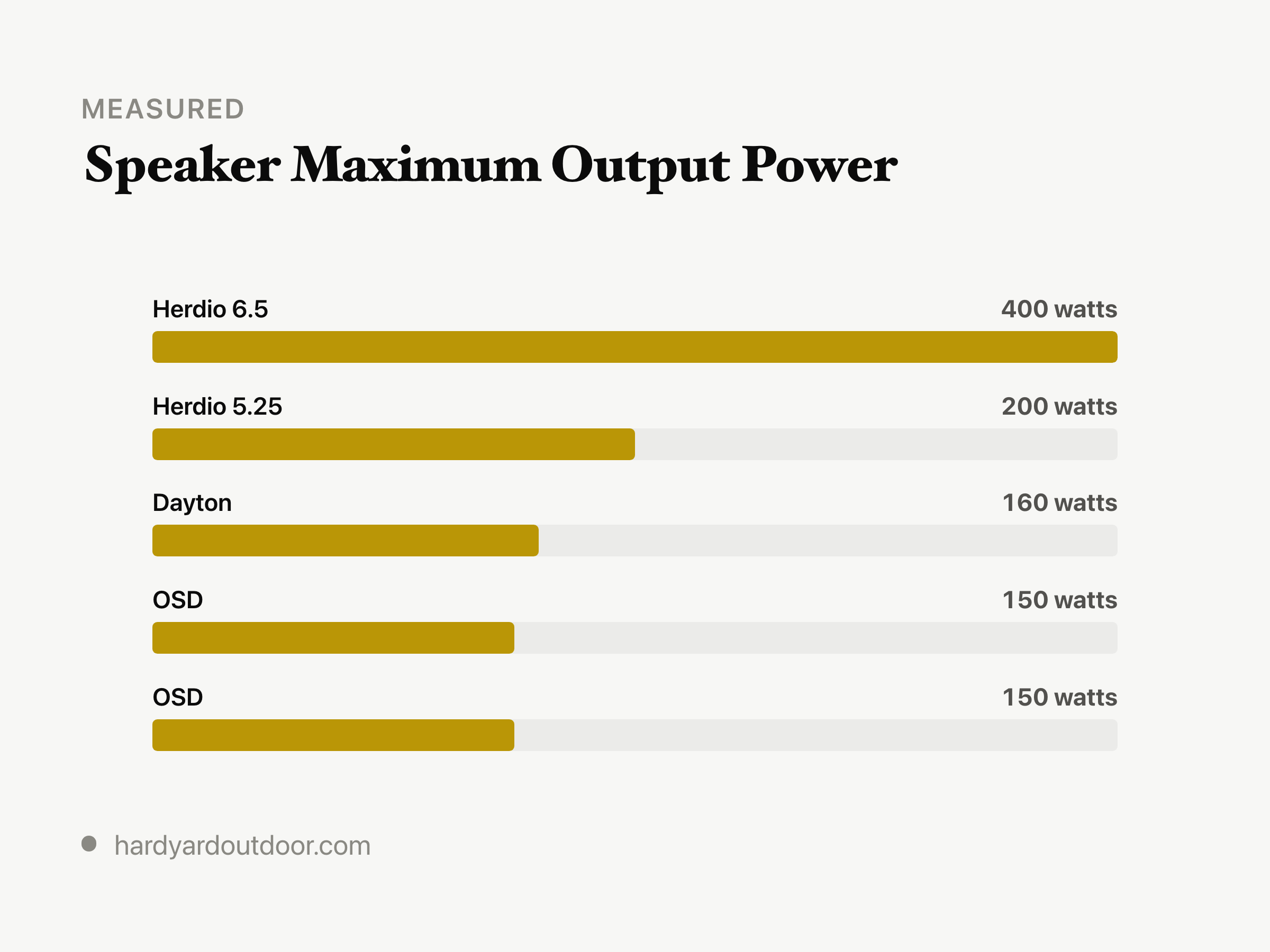
- Need speaker maximum output power under 160 watts? → Victrola Rock
- Around 160 watts is enough? → Dayton
- Need every bit of speaker maximum output power you can get? → Herdio 6.5
Three layouts for the same 400 sq ft patio
Take a 20 by 20 foot patio, speakers mounted at 9 feet under an eave, listeners at 4 feet seated. That gives a 5-foot mounting height above the ear plane, and a hypothetical 90-degree conical pattern that would put a 10-foot coverage circle on each speaker. Everything below follows from that one circle, though no source shows what coverage an outdoor speaker at 9 feet actually produces.
The three options, all arithmetic from the illustrative circle above rather than figures any source publishes:
- Edge-to-edge: the circles touch but do not overlap. Four speakers, spaced 10 feet on centre, with lower level wherever two circles meet.
- Edge-to-centre: each speaker sits on the edge of its neighbour's circle, so spacing drops to about 7 feet and the same patio wants nine.
- Partial overlap: roughly 8.5 feet apart, six speakers, sitting between the other two.
XTEN-AV describes these as the three standard ways a layout gets specified: edge-to-edge for broad coverage, edge-to-centre for deeper overlap, or partial overlap to cover a space with fewer speakers. XTEN-AV also notes that maximum-overlap layouts suit high-SPL applications but raise the number of speakers needed.
Power is a separate question
Coverage geometry answers how many speakers and where, which is a separate question from how much power each one needs. No source consulted here gives watts-per-speaker guidance for outdoor coverage. Audio Advice makes the point plainly: with one loud pair, the people sitting near it cannot hold a conversation while the people at the far end barely hear it. Paradyme's alternative is more speakers at lower volume, and for a medium yard, four spaced around the perimeter each playing moderately.
Paradyme names underpowering the space as a common buying mistake and recommends more speakers playing moderately: for a medium yard, four around the perimeter. Paradyme notes that higher-sensitivity speakers, measured in dB, need less power to play loudly and work well with most receivers or amps.
Awkward shapes: L-plans, narrow decks, pool perimeters, half-covered pergolas
Irregular shapes complicate the spacing rules of thumb, though no source addresses them directly. Four cases follow, extrapolated from the general guidance above.
- L-shaped patios: Winston Acoustics frames the goal as coverage that overlaps gently with no corner dropping out, which suggests treating the two legs as separate zones. No source addresses L-shaped layouts specifically, or compares a pair per leg against speakers fanned from the joint.
- Long narrow decks: Audio Advice suggests multiple pairs for a deck running the full back of a house, either under the eaves or on the deck edge firing back at the house. Audio Advice does not say at what eave height or deck depth one option beats the other.
- Pool perimeters: where there is nowhere to mount a speaker, Paradyme says in-ground and bollard speakers provide 360-degree sound suited to large areas, though elsewhere in the same guide Paradyme describes bollard or stake speakers as providing near 360-degree coverage. Audio Advice says landscape designs deliver good midrange and treble but no bass, which is why they are paired with a subwoofer buried in the ground. If you would rather not dig, the Victrola Rock Speaker Connect can be wirelessly connected in groups of up to 20 units to build one larger system.
- Half-covered pergolas: Audio Advice says a covered porch with walls on three sides and under about 20 feet long generally needs only one pair, while a long porch open at both ends may need two pairs. Winston Acoustics says a standard 8-ohm setup is fine for a few speakers close together, but many speakers spread across a garden or large terrace call for a 70V or 100V line system. It does not give a speaker count at which the switch happens.
Which of these eight suits which patio
None of these was tested here. This is a comparison of published specifications against the geometry set out above, and where a listing contradicts itself, I say so rather than pick the flattering number.
Aiming and area
Aiming range affects where a speaker's coverage lands. No source consulted here gives rotation or tilt figures for the OSD Audio AP650, so its aiming range cannot be compared against the others. Wirecutter reports that a pair of AP650s can fill an outdoor space of up to about 1,500 square feet even on a small amplifier, and directs buyers above that to its upgrade pick. It does not state the shape of that area, the spacing, the mounting height, or the volume at which the figure holds.
No source consulted here gives mounting or swivel specifications for the Herdio pairs. Wirecutter notes the IO8XTB is roughly twice the size of the AP650 but offers at least twice the performance, and that its grille dents easily and its binding posts are awkwardly positioned, making the speaker wire trickier to connect.
Weather ratings that disagree
Winston Acoustics says IP44 is generally the lowest rating suitable for outdoor use, while Paradyme recommends IPX4 or higher for speakers that may get wet and IPX6 or better poolside. The two thresholds conflict, and no source resolves them.
No source consulted here gives IP ratings for the Herdio pairs or the Dayton IO8XTB. Wirecutter describes the AP650 as fully sealed with an IPX6 rating, so water and bugs are not a concern; since the X leaves dust protection unspecified, per Winston Acoustics' explanation of IP digits, that number says nothing about dust ingress.
So: which one
- Wall-mounted pair, patio under about 1,500 square feet, amplifier indoors: the AP650, which Wirecutter notes is passive and so needs an external amplifier plus a speaker-wire run to each speaker. Paradyme does advise at least 5.25-inch woofers for broad coverage, with 6.5-inch or 8-inch drivers for larger spaces.
- One large zone where you can run wire: the Dayton IO8XTB, which Wirecutter says offers at least twice the AP650's performance at roughly twice the size, sold individually at $200 so a pair runs about $400.
- The Herdio pairs: no source consulted here covers them, so no recommendation can be made.
No wiring anywhere? The Victrola Rock Speaker Connect can be wirelessly connected in groups of up to 20 units, and is sold individually at $150 so a stereo pair costs double. Wirecutter notes it has noticeably less bass than its other picks, and Maria Decora calls rock speakers a background-listening choice rather than a party one.
Audio Advice argues for even sound distribution over one loud pair, because listeners close to a loud pair cannot hold a conversation while distant listeners barely hear it. If you are also working out where those chairs can sit, fire pit clearance distances constrain the same plan. Over winter, check any speaker cover against your own cabinet dimensions. Measure first.
Our call
OSD, best for covering a mid-sized patio from the house wall when you want the speakers to disappear against light-coloured siding and can run wire from an indoor amp.
A different situation changes the pick:
- For a large patio or courtyard wired as a distributed 70V/100V system, where one or two speakers must cover ground without a subwoofer: Dayton.
- For a covered deck or garage where you want the most bass per speaker from a compact wired pair and are willing to accept a lower weather rating: Herdio 6.5.
- For a small balcony, porch or narrow eave run where cabinet depth matters more than output: Herdio 5.25.
One caveat on the OSD: listing states IP54 in the title but IPX6 in the description, so the actual weather rating is ambiguous
Questions
How do you calculate outdoor speaker coverage?
Use D = 2(H−h)tan(C/2) from the AVIXA CTS-D guidelines, where D is the coverage circle diameter, H the mounting height, h the ear height (4 feet seated) and C the coverage angle. A 90-degree speaker at 9 feet covers 2 × 5 × tan(45°) = 10 feet across.
How high should outdoor speakers be mounted?
Paradyme recommends 8 to 10 feet above the ground, angled down toward the seating. Height matters because the coverage formula uses height above seated ear level, not above the ground: at 9 feet, only 5 feet of that height is doing work for a listener sitting at 4 feet.
How far apart should outdoor speakers be?
Paradyme gives 8 to 10 feet for a stereo pair and Maria Decora suggests 10 to 15 feet for rock speakers aimed at the main seating. Neither ties spacing to mounting height, room size or listening distance, so run the coverage formula for your own height before trusting either figure.
Why does my patio have loud spots and dead spots?
Published dispersion angles overstate real coverage. XTEN-AV puts effective coverage at 70 to 80 percent of the nominal figure, so a 120-degree speaker performs like 85 to 95 degrees — a circle 42 percent smaller in diameter. Outdoors there are no walls or ceilings to reflect sound into the gap.
Sources
- The Best Outdoor Speakers for your patio, screen porch, or backyard – Audio Advice accessed 2026-08-05
- The 4 Best Outdoor Speakers of 2026 | Reviews by Wirecutter Advertisement accessed 2026-08-05
- The Ultimate Outdoor Speaker Guide for 2025 accessed 2026-08-05
- Ceiling Speaker Placement Calculator | XTEN-AV accessed 2026-08-05
- What to Look for When Buying Outdoor Speakers - Paradyme accessed 2026-08-05
- Commercial Outdoor Speakers: IP65 Buying Guide accessed 2026-08-05
- Rock Outdoor Speakers: The Complete Buying Guide for 2026 accessed 2026-08-05