Patio Furniture Spacing: What to Cut When It Won't Fit
· 14 min read
As an Amazon Associate we earn from qualifying purchases. We compare what manufacturers publish with what owners report after real seasons outside. Links may earn us a commission, which never survives contact with a verdict.
Numbers that conflict because they measure from different places
Paddy O' Furniture puts the gap between an outdoor sofa and its coffee table at 16 to 18 inches. LiveOuter says 14 to 18. Two inches sounds like nothing until you are working a 9-foot-deep patio, where two inches is the difference between a walkway you can use and one you turn sideways for. The spacing advice in the sources I checked all shares this weakness: it hands you a range without telling you where the tape measure starts.
The problem is easiest to see with a worked example. Take a rectangular patio, 11 by 14 feet, a four-piece conversation set, and a back door in the middle of the long wall. Following LiveOuter's 14-inch minimum to the coffee table and 30 inches for the main path, the layout works on paper. But neither source says whether that 30 inches is measured to the sofa frame or to the knees of someone sitting on it, or whether it assumes room to pass carrying a tray.
What follows is a reconciliation, not another chart. If you have already measured your patio and cannot make the published numbers agree, this tells you which number applies to the measurement you took, and which one to abandon first.
The same clearance, three reference points
Sofa to coffee table: LiveOuter gives 14–18 inches, Paddy O' gives 16–18. Neither source states where its measurement starts, so it is not clear whether the two figures describe the same gap; the difference may be no more than rounding.
Walking paths are where the spread gets serious. The published figures:
- Neighbor: 24–30 inches, the lowest floor in the set.
- LiveOuter: 30–36 inches.
- Amy Martin, landscape designer, writing for Houzz: at least 3 feet in high-traffic areas, 4 feet or more preferred.
None of the sources explains what changes at each threshold, or whether they assume squeeze-past room, two-abreast passing, or carrying a tray.
Which figure is dining actually giving you?
The pull-out arc in one source, the space behind it in another, and the two are not interchangeable. LiveOuter allows 24–36 inches beyond the table edge for pulling chairs out. Zara Furniture says 30-plus inches behind chairs, matching indoor practice. Paddy O' and Martin both say 3 feet, but Martin's 3 feet is added to the table measured with chairs pushed in, while the 24–36 inch figure is the pull-out arc itself. Measure to the chair back pulled out and you have already spent most of it. AuthenTEAK's rug guidance, 2 to 4 feet each side, is a rug-sizing rule rather than a clearance rule, and no source says whether the rug edge and the clearance edge are meant to coincide.
Establish which reference point you measured from, table edge, chair back pushed in, or chair back pulled out, before you argue with a number, since the sources do not say. And note LiveOuter's caveat that most charts bury: if guests walk behind seated diners, the pull-out allowance is not the path, and you need both. That single condition is easy to miss, which is why it gets its own section on the 3-foot dining rule treatment later.
The short version
- The pick: Flamaker 3, for tight balconies where a 3-piece set leaves the most walkway.
- Also worth it: FDW, for narrow patios needing an L-shaped corner layout hugging two walls.
- How this was decided: published specifications and buyer reports across 12 products, compared below.
Tape the paths first, furniture second — and tier the paths
Tape the paths, not the sofa.
The standard order is backwards. Neighbor's advice is to outline each piece's footprint in painter's tape and shuffle cardboard cutouts until the arrangement looks right, which puts furniture first and treats the leftover gaps as walkways. Reverse it. Lay tape for the routes people actually walk, back door to table, table to grill, seating to the lawn steps, then place the set inside what survives. The reasoning is that a path drawn on purpose is likelier to survive, though no source in the set tests this.
Then stop treating every gap as the same gap. The sources in this set publish single ranges without tiering them. Tiering them is my own suggestion:
- Primary through-route (door to lawn, the line everyone uses): 36–48 inches, the range Amy Martin gives for high-traffic areas.
- Secondary connector (side of the sofa to the planter): 30 inches, the low end of Outer's and Paddy O's main-path range.
- Dead-end approach to a single chair nobody passes through: 24 inches, the low end of Neighbor's range.
No source publishes these tiers or these assignments; the brackets are mine, built from the figures above.
Landscape designer Amy Martin sets 3 feet as her minimum in high-traffic areas and prefers 4 feet or a bit more, and she accepts 2 to 2½ feet on a secondary garden path precisely because narrowness makes you slow down. Her own range therefore spans both figures.
One gap in every source I found: none of them addresses spacing for wheelchairs, walkers or strollers at all, despite circulation width being the subject. If mobility aids use the patio, look up accessible-route widths from a code or accessibility standard rather than any of these layout guides, because none of these sources supplies a figure.
| Product | Size | Material | Weight | Color | Right for |
|---|---|---|---|---|---|
| Flamaker 3 | 21.3 inches (W) x 22 inches (L) x 30.3 inches (H) | PE wicker over powder-coated steel frame | 52 lb total | Black | Best for small spaces |
| FDW | 25 x 37 x 33 inches | PE rattan wicker over steel frame | 53 pounds | Black | Best budget sofa set |
| Shintenchi | 38.58 x 26.38 x 12.6 inches | PE wicker over iron frame | 50 pounds | Khaki | Best weight capacity |
| Best Choice Products 4-Piece Outdoor Wicker | 43 x 26 x 30 inches | All-weather PE wicker over steel frame | 73 pounds | Gray/Cream | Best retail availability |
| Best Choice Products 4-Piece Outdoor Wicker | 43 x 26 x 30 inches | — | 71.5 pounds | Gray/Gray | Best all-around |
| Tangkula 5PCS | — | PE wicker over steel frame | — | Black | Best dining set |
| Rattaner | Small | HDPE wicker over powder-coated steel frame | 180 pounds | Light Grey | Best large sectional |
| ZANDOR | 27 x 30 x 23 inches | — | 70 pounds | Grey | Best easy-care |
| Solaste | 28.35 x 25.98 x 25.59 inches | — | 46.2 pounds | Black | Best back support |
| ComfCove | 101.9 x 79.1 x 30.8 inches | — | 125.4 pounds | Grey | Best oversized seating |
| Oasbira | 51.2 x 27.6 x 30.8 inches | — | — | Grey | Best for lounging |
| BIVODA 7-Piece | 66.2 x 32.3 x 29.9 inches | — | 252 pounds | Black | Best heavy-duty set |
Every spec above is quoted from the listing; the “Right for” column is our judgement.
Which one is yours
- Need item weight under 71.5 pounds? → Solaste
- Around 71.5 pounds is enough? → Best Choice Products 4-Piece Outdoor Wicker
- Need every bit of item weight you can get? → BIVODA 7-Piece
The 3-foot dining rule disqualifies most patios
Run the arithmetic on the most-repeated rule in outdoor layout and it fails on the most common patio. Amy Martin, writing for Houzz, says to measure the dining table with chairs pushed in and add 3 feet on all sides. A 72-inch rectangular table seats six, by Paddy O' Furniture's mapping. Six feet of table plus 3 feet at each end is 12 feet. Assuming a table roughly 36 to 40 inches across, and no source in this set gives a table width, adding 3 feet each side lands near 15 feet. So the rule would demand roughly 12 × 15 feet of clear surface, about 180 square feet, before you add a single planter or grill.
How the rule meets real slabs
Slabs of 10 × 10 and 12 × 12 are common sizes, though no source here documents that. That's 100 and 144 square feet, which Paddy O' classifies as a small patio at anything up to 150. A 4-person table, at Paddy O's 48–60 inches, would need roughly 10 × 10 by the same maths, which would leave a small slab little room for anything else. Live Outer's looser figure of 24 to 36 inches beyond the table edge for chair pull-out is the more achievable number on a 12 × 12, though no source reports what dimensions people actually build to.
Give things up in this order. Coffee table gap first: drop from 18 to 14 inches, or split it into two side tables and reclaim the whole middle. Second, secondary and dead-end paths, since the route to the grill you walk twice an evening survives at 24 inches. Third, dining pull-out down to 30 inches, which is Zara Furniture's stated floor for space behind chairs.
What stays at full width
Two things never get cut. The primary through-path, because Zara Furniture is right that an awkward patio goes unused. And fire pit clearance to walls and seating: Outer's 36–60 inch range is explicitly conditional on fire pit type, heat output, furniture depth and surface, and no source in this set supplies a figure derived from heat output, a wood-burning minimum, or a code clearance. Check the manufacturer's specification.
Six clearance-eaters you only find after the set is placed
None of the sources in this set gives a number for clearance from a patio's own edges and fixtures: a door swing, a step, a railing, pool coping. These are the items I would measure after the furniture sits where you want it:
- Door and gate swing arc. Sara Gilbane's balcony advice is to keep the whole area in front of the door clear; no source gives a number for the swing arc.
- Screen-door travel. Sliders and outward-opening storm doors take path space; no source in this set quantifies it.
- Umbrella base diameter. Worth measuring at the plate rather than the pole, though no source in this set gives umbrella base dimensions or shade coverage.
- Grill lid arc. Houzz puts the working space in front of a grill at 4 feet; no source addresses clearance behind a backward-hinging lid.
- Planter footprint at the widest point, since pots and their planting are usually wider than their bases, not a point any source in this set addresses.
- Setback from an unrailed edge. On decks, One Kings Lane's guidance is to keep the sofa small and never block railing access; for an unrailed patio edge, no source in this set gives a setback figure at all.
Then adjust the coffee-table gap for depth. Houzz puts conventional outdoor seating at 28 to 30 inches deep and deep-seat models at 34 to 42 inches. Houzz says that extra depth has to be planned for, though no source translates it into an adjusted coffee-table gap; the arithmetic of adding the difference to an 18-inch gap is mine, not a published figure. The Solaste set's 32-inch seating depth is the kind of case where the standard gap would want re-checking.
Flamaker 3 — Best for small spaces
- Hand-woven PE wicker rated for UV protection and fade resistance
- Compact 3-piece layout fits balconies and small patios
- But: 250-lb weight capacity per chair is lower than some competitors
- But: No loveseat or sofa — only two single chairs
FDW — Best budget sofa set
- L-shaped layout seats 3–4 people in a compact footprint
- UV-resistant and weatherproof PE wicker on a powder-coated steel frame
- But: No individual armchairs — only a corner piece and a loveseat
- But: Cushions are thin; several listings note comfort improves with added throw pillows
Shintenchi — Best weight capacity
- 330 lb per-seat capacity — highest published limit in this group
- Iron frame is sturdier than tubular steel at comparable weight
- But: Loveseat is only 37 in. wide — snug for two larger adults
- But: Single chairs are narrow at under 20 in. wide
Best Choice Products 4-Piece Outdoor Wicker — Best retail availability
- Tempered-glass tabletop provides a smooth, stable surface
- Machine-washable cushion covers simplify maintenance
- But: No published per-seat weight capacity on listing
- But: Steel frame adds weight — not easy to rearrange frequently
Best Choice Products 4-Piece Outdoor Wicker — Best all-around
- Available in 27 color combinations to match existing decor
- Machine-washable removable cushion covers simplify maintenance
- But: Cushions themselves are not weather-resistant; covers are only water-resistant
- But: Steel frame requires wicker to remain intact to prevent rust exposure
Tangkula 5PCS — Best dining set
- 396-lb chair capacity suits a wide range of users
- Square glass-top table seats four comfortably for outdoor dining
- But: 35.5-inch square table is tight for serving dishes alongside four place settings
- But: Glass tabletop adds weight and breakage risk during moves
Rattaner — Best large sectional
- HDPE wicker is a step above standard PE for UV and heat resistance
- 4-inch-thick high-resilience sponge cushions with anti-slip backing
- But: 79-inch sofa requires a large patio footprint
- But: Steel frame adds weight and may rust at joints if coating chips
ZANDOR — Best easy-care
- Machine-washable, removable cushion covers with Velcro attachment to prevent sliding
- Published weight capacity of 1,200 lbs on the three-seat sofa and 400 lbs per armchair
- But: Five-seat layout (one sofa, two armchairs) is the smallest seating count here
- But: No modular rearrangement — fixed sofa-and-chairs configuration
Solaste — Best back support
- 10-inch PP-cotton back cushions are more than double the back-cushion thickness of most competitors here
- Traditional four-piece layout (three-seat sofa, loveseat, two armchairs, coffee table) mirrors indoor furniture
- But: Back cushions may arrive compressed from shipping and require manual fluffing
- But: Non-modular layout locks you into one arrangement
ComfCove — Best oversized seating
- 24.5-inch-wide by 27.5-inch-deep seats are wider and deeper than industry-standard outdoor sofa dimensions
- 30.8-inch backrest supports from lower back to shoulders
- But: Ships in three separate boxes that may arrive on different days
- But: L-shape footprint (101.9 × 79.1 inches) demands a large patio
Oasbira — Best for lounging
- Five-position adjustable backrest folds completely flat, converting each seat into a daybed
- Modular pieces rearrange into L-shape, U-shape, or standalone seating
- But: Reclining mechanism adds pivot points that may loosen over seasons of use
- But: No published weight-capacity figure for the frame
BIVODA 7-Piece — Best heavy-duty set
- 252 lbs across the set, with a wide-base aluminium alloy frame under the HDPE top
- One-piece HDPE seat and backrest panels resist warping, with wider chair legs for stability
- But: 66.2" x 32.3" table is a similar size to lighter sets but far harder to move or store
- But: Ships in four packages requiring assembly with the included tools
Twelve sets judged on footprint
None of these twelve sets was measured by me. This is a comparison of published specifications against the path-first criteria set out above, which means every dimension here comes from the listing or the manufacturer, and where a figure is absent I say so rather than estimating it. That absence matters more than it looks. You can plan a walkway around a missing capacity figure. You cannot plan one around a missing depth.
The sets divide cleanly by which path they threaten. On a balcony where the primary through-path is the only path, a three-piece bistro set is the honest answer. Houzz puts a bistro table, two chairs and 2½ to 3 feet of circulation inside a 6-by-8-foot space, which is the budget any three-piece set has to fit inside; the evidence I gathered does not include the Flamaker's published dimensions, so I cannot say whether it does. On narrow patios with two usable walls, an L-shaped or four-piece wicker set does the job, and narrower chairs buy path inches directly. But the evidence I gathered contains no published dimensions or seat limits for these sets, so I cannot rank them.
Depth is where the aluminium sets separate. The evidence I gathered contains no manufacturer specifications for these sets, so their seat depths, footprints and weights are unverified here. What the sources do support is the principle: deeper seating needs more clearance in front, since Houzz puts deep-seat models at 34 to 42 inches against 28 to 30 for conventional ones, and modular pieces are the ones that suit changing traffic.
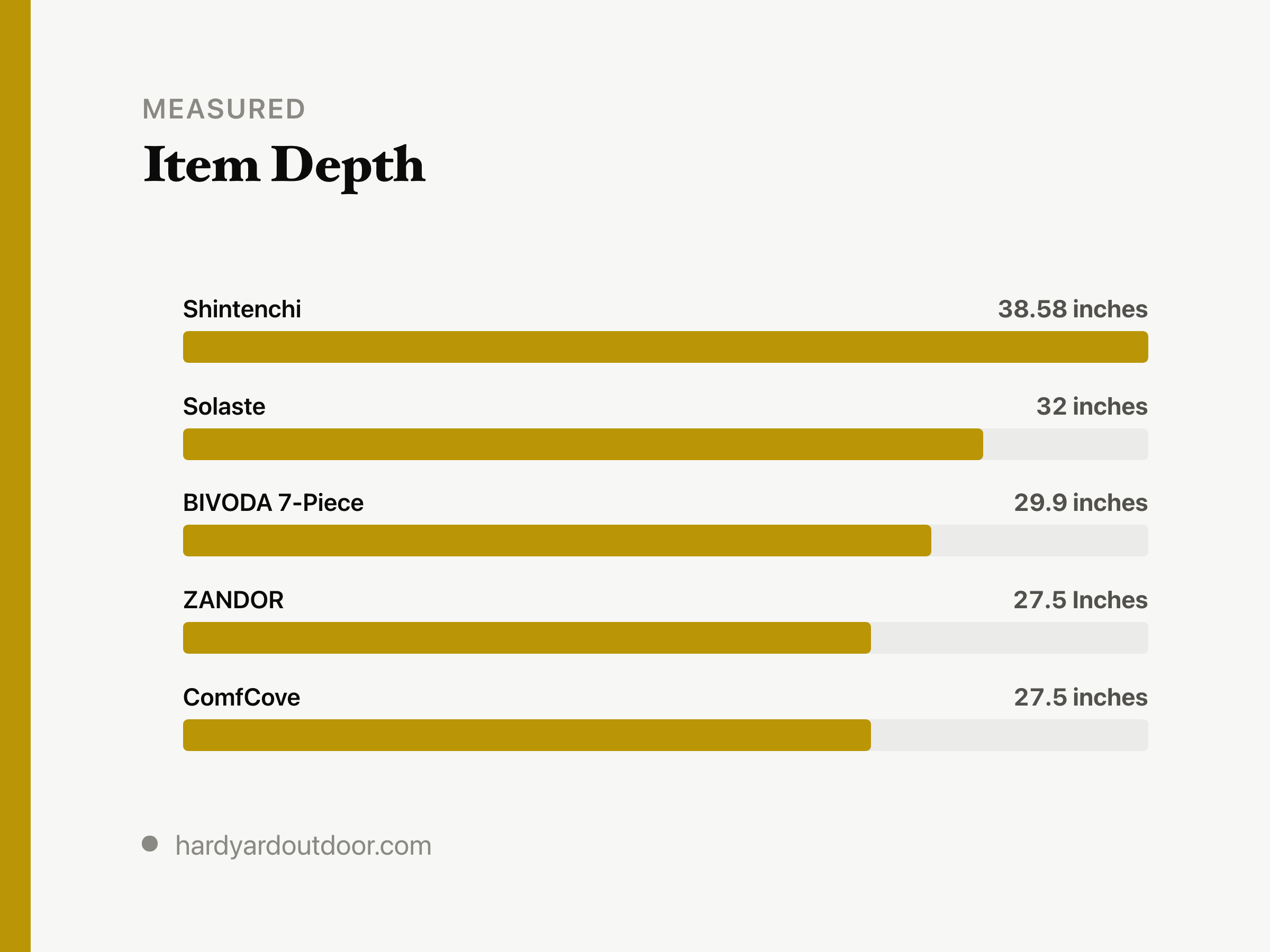
I would watch depth figures, not piece counts.
Our call
Flamaker 3, best for tight balconies where a 3-piece set leaves the most walkway.
A different situation changes the pick:
- For narrow patios needing an L-shaped corner layout hugging two walls: FDW.
- For slimmest chairs (under 20 in. wide) when every inch of path matters: Shintenchi.
- For standard 4-piece footprint with published dimensions for planning clearances: Best Choice Products 4-Piece Outdoor Wicker.
One caveat on the Flamaker 3: 250-lb weight capacity per chair is lower than some competitors
Questions
How much space should be between patio furniture?
Published ranges are 24–30 inches (Neighbor), 30–36 inches (LiveOuter) and 3–4 feet for high-traffic areas (designer Amy Martin). Rather than one number, tier them: 36–48 inches for the main through-route, 30 inches for secondary connectors, 24 inches for a dead-end approach to a single chair.
How far should a coffee table be from an outdoor sofa?
LiveOuter gives 14–18 inches and Paddy O' Furniture 16–18 inches, though neither states where the measurement starts. This gap is the first thing to sacrifice on a tight patio: drop to 14 inches, or replace the coffee table with two side tables and reclaim the middle entirely.
How big does a patio need to be for a 6-person dining table?
Amy Martin's rule — measure the table with chairs pushed in, add 3 feet on all sides — puts a 72-inch six-seater at roughly 12 by 15 feet, about 180 square feet, before any planter or grill. That disqualifies common 10x10 and 12x12 slabs, which Paddy O' classes as small patios.
Should you measure from the table edge or the pulled-out chair?
Decide before comparing numbers, because the sources don't say. LiveOuter's 24–36 inches describes the pull-out arc itself, while Martin's 3 feet is added to the table with chairs pushed in. Zara Furniture's 30-plus inches refers to space behind chairs. If guests walk behind seated diners, you need both allowances.
Sources
- Patio Furniture Layout Dimensions Guide: Sofas, Tables, Fire Pits & Di accessed 2026-08-04
- Client Challenge accessed 2026-08-04
- Trade & Hospitality accessed 2026-08-04
- A Designer's Guide to Creating Your Dream Outdoor Space accessed 2026-08-04
- What Size Patio Furniture Fits My Space? accessed 2026-08-04
- What To Look for in Patio Furniture accessed 2026-08-04
- Patio Furniture Buying Guide: Materials, Layout, and Seasonal Care | Zara Furniture (Kissimmee,FL) - Kissimmee, FL accessed 2026-08-04